Home Security Mistakes DFW Homeowners Make
December 16, 2026 · DFW Key Master Team · 5 min read
Home security fails more often through habit than through hardware. The house with a $200 deadbolt and a key under the mat is less secure than the house with a basic cylinder and no spare anywhere outdoors.
These are the mistakes we see in DFW homes repeatedly, ordered by how often they lead to an actual problem.
The hidden spare key
Under the mat, in the flower pot, behind the shutter, in the lockbox with the factory combination, inside the mailbox. Every one of these has been used by a thief, and the first three are checked by burglars as a routine, not as a lucky guess.
A spare has to exist, because the alternative is a lockout. The right answer is a key that lives with a neighbor or a family member, or a keyed lockbox mounted out of street view with the combination changed from the default. Our guide to hiding a spare key covers the options that work.
A related mistake: leaving the spare outdoors permanently and then never checking it. A hide-a-key box in a DFW summer cracks, and a key that has sat in one for three years often no longer works.
One key for everything
A single key that opens the front door, the back door, the garage entry and the mailbox is convenient right up to the moment it is lost or lent out.
What matters is knowing what a single key controls. If a contractor, a cleaner, or an ex-partner holds one key, they hold every door. Either accept that consciously or split the system: house doors on one key, outbuildings and the mailbox separate.
And when a key does leave your control, rekey rather than hope. Our piece on locks after a termination covers the process, and it is the same process for a household.
The weak strike plate
This is the highest-value fix in this article and the least expensive. Builder hardware typically ships with a strike plate held by two screws an inch long, going into the pine jamb. A firm kick breaks the jamb, not the lock.
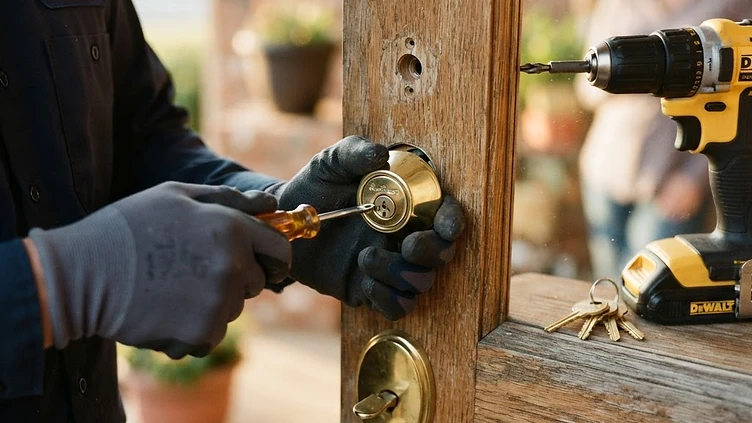
A reinforced strike with three-inch screws into the stud, plus a jamb plate, closes the gap. It costs little and it does more than upgrading the cylinder. Our door frame guide and the deadbolt installation piece cover the work.
Ignoring the side and back doors
Front doors get all the attention. Side doors, garage entry doors and the door from a converted garage into the house get whatever hardware the builder left there, or less, because the previous owner added a pet flap and removed the deadbolt.
Nearly every security failure story in a neighborhood starts at the door nobody thought about. Walk the house and confirm every exterior door has a deadbolt in a properly fitted strike, including the one to the yard.
The garage as a route
An attached garage is a door into the house with a large vehicle entrance in front of it. A coded garage door opener with a default code, or an unsecured pedestrian door with a builder knob, turns the garage into the easiest way in.
Change the opener code, fit a deadbolt on the house door, and if there is a window into the garage, treat it as a route rather than a window. Our garage door security piece covers the details.
Code sharing on keypads and smart locks
A keypad with one code shared by the whole family is a code that gets given to a dog walker, a cleaner and a guest, and never revoked.
Use individual codes where the lock supports them, delete them when the arrangement ends, and check the access history when something feels off. A keypad's value is the ability to revoke, and most households never use it.
Posting the schedule
The box on the porch for a vacation delivery is an advertisement. So is a social media post from the airport. So is a driveway with two cars gone for a week.
Pausing mail, holding packages, and having a neighbor park in the drive are the standard answers, and our vacation preparation guide lays them out.
The chain lock, the patio bolt and the false sense of security
A chain lock is a privacy device, not a security device; it is defeated by a hand through the gap and a screwdriver. A patio bolt on a door with a full pane of glass is decoration, because the glass is the way in.
What works on a glass door is laminate or security film, a properly fitted secondary lock, and a deadbolt keyed from both sides only if the key is kept nearby for egress. Getting that wrong is its own mistake, and our sliding door piece covers how to do it without trapping yourself inside.
Leaving tools and ladders out
A ladder in the backyard, a wheelie bin by the fence, a garden table under a window: all of them are the steps a burglar needs to reach a first-floor window. Put them away, and if the window has no lock, that is worth fixing too.
Never testing anything
The final and most common mistake: nobody in the house has ever tried the back door deadbolt, the garage keypad, the window locks or the alarm in a year. Hardware seizes, codes get forgotten, batteries die.
Do a five-minute check twice a year. Lock every door and window from outside where possible, then try each from the inside. Spray the keyholes with graphite. Replace the smoke alarm batteries while you are at it.
Fixing it in one afternoon
If you only do three things after reading this: take the spare key out of the garden, add reinforced strikes with long screws to the front and back doors, and check every exterior door actually latches when locked. That set costs less than one emergency call and removes most of the realistic risk.
When to call a pro
Call DFW Key Master at (682) 666-2966 for a door-by-door security assessment, rekeys after a key leaves your control, reinforced strikes, or a deadbolt on the door that never got one. Our residential team covers Dallas–Fort Worth, and our front door guide is the place to start if you want the detail.
FAQ
What is the biggest home security mistake?
A spare key hidden outdoors, and a front door whose strike plate is held by two short screws. Both are free or cheap to fix and both defeat good locks.
Should every exterior door have a deadbolt?
Yes, including the side door and the garage entry. That is where most real failures happen, because nobody upgrades those doors.
Is a chain lock enough for an apartment?
No. It is a privacy device. A deadbolt with a reinforced strike is what resists entry.
How often should home lock hardware be checked?
Twice a year, along with smoke alarm batteries. Test the latch, lubricate with graphite, and confirm codes on keypads still work.
Fix the habits, not just the hardware. Call DFW Key Master at (682) 666-2966.