How Do Celebrities Protect Their Homes?
September 26, 2026 · DFW Key Master Team · 5 min read
Celebrity home security is mostly the same set of ideas every homeowner uses, just executed with more money, more layers and fewer compromises. Nobody protects a house with one clever gadget. They build distance, control who reaches the door, and make sure the boring hardware actually works.
Here's what those setups look like, and which parts translate to a normal home in Irving, Plano or Fort Worth.
It starts at the property line, not the front door
In a typical high-profile property, the security perimeter begins at a gate, a wall or a landscaped setback. The point isn't to stop a determined intruder at the gate; it's to create distance, slow approach, and give cameras and staff time to see someone coming.
Even without a gate, most homes can borrow the idea. Motion lighting along the sides and rear, trimmed shrubs so there's no place to stand unseen, a visible camera at the driveway, and a clear sightline from the street to the front door all reproduce the effect at low cost. Most break-ins happen at a door that isn't visible from the road.
Layered security beats one expensive system
The pattern in professionally protected homes is redundancy: exterior cameras, interior sensors, door and window contacts, glass-break detection, and a monitored alarm, with someone who actually responds. No single layer is expected to work alone.
For a normal house, three layers are usually enough: deterrence (lighting, cameras, signage), delay (good deadbolts, reinforced strikes, solid doors, window locks) and detection (an alarm with monitoring). Spend evenly across all three instead of putting the whole budget into cameras. A camera records a burglary; a deadbolt and a strike plate prevent one.
Access control for staff, vendors and guests
Big homes have staff, contractors, dog walkers, pool companies and guests coming and going, and managing that access is the hardest part of the job. The usual answer is keypad or smart-lock codes issued per person, scheduled to the hours they should be there, and revoked when they leave.
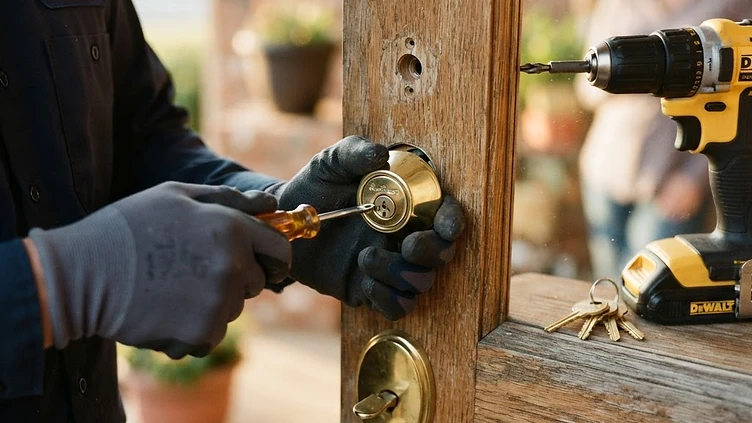
That's the single most transferable idea on this list. A keypad deadbolt on the main doors, a separate code for the cleaner, the contractor and the pet sitter, and a habit of deleting codes when the job ends is something any homeowner can set up in an afternoon. It also removes the hidden key problem entirely.
Privacy changes the architecture
Celebrity homes are often designed so nobody can see in: set-back windows, frosted glass, high hedges, garage entries that lead straight into the house so nobody is photographed getting out of a car. Some use gated motor courts and separate delivery areas.
You don't need any of that to benefit from the reasoning. If your front door is fully glazed, if the garage is the only entrance you ever use, or if a side gate leads to an unlit back door, those are the weak points worth addressing. Frosted film on a sidelight costs very little and removes an easy break-and-reach.
The parts you can copy on a normal budget
The high-value moves, roughly in order:
- Reinforce every exterior door frame and strike plate. It's the cheapest delay you can buy.
- Rekey everything on move-in so you know exactly who holds keys.
- Add motion lighting at the rear and sides, where most DFW break-ins happen.
- Put a keypad or smart lock on the main entry and manage codes per person.
- Use a monitored alarm, not just a siren.
- Keep the perimeter visible: no ladder, no unlatched gate, no package pile by the door.
If you're moving into a new place, our rekey service covers the second item properly, including patios and garage entry doors that people forget.
What famous-home security sometimes gets wrong
More technology isn't always more secure. We've seen very expensive homes with a beautiful front door that had a one-inch strike screw, cameras that nobody monitors, and a gate code shared with every contractor in the neighborhood since 2019.
The pattern to avoid: treat hardware as decoration. A door is only as good as the frame around it, and a code list is only as good as the person maintaining it. Before you add another camera, walk the doors.
When to call a pro
Call a locksmith when you need a full rekey, when a door or frame needs reinforcing, when you want keypads installed on multiple entries with managed codes, or when you're coordinating a move or a renovation. We handle residential hardening across Dallas–Fort Worth, from single-door reinforcement to whole-property key schedules, and we'll tell you what's actually weak rather than selling you a system you don't need.
If you're planning a trip, our guide to preparing your home before vacation covers the checklist angle.
FAQ
Do celebrities really have panic rooms?
Some do, but it's a small part of the picture. The bigger investments are perimeter control, staff and vendor management, and monitored systems that someone responds to. A safe room is the last layer, not the first.
What is the most important home security upgrade?
Door and frame reinforcement, followed by lighting and a working alarm. Most burglaries involve forcing a door, and most forced doors fail at the frame rather than the lock.
Are smart locks safe for a main entrance?
Reputable smart deadbolts are fine on a solid door with a reinforced strike, provided you use individual codes, keep a physical key stored safely, and update the lock's firmware. The lock is not the weak point; the door and frame usually are.
How much does professional home security hardening cost?
It depends on door count and hardware. A rekey and strike-plate reinforcement on a typical DFW house is a modest job; adding keypads and multiple entries costs more. Call (682) 666-2966 for a firm quote before any work.
Celebrity-grade security is mostly ordinary discipline applied consistently. Call DFW Key Master at (682) 666-2966 and we'll start with the doors, which is where it always starts.