4 Essential Things to Check Before Using an Automotive Locksmith
November 5, 2026 · DFW Key Master Team · 4 min read
A residential locksmith and an automotive locksmith are different trades. Car doors, transponder chips, immobilizers and key programming need specific tools and training, and a company that is excellent at rekeying houses may have no business touching a modern vehicle.
Before you hand over your keys — or confirm a dispatch — check these four things.
1. Do they actually do automotive work?
Ask directly: do you do car lockouts and key programming, and can you program a key for my make, model and year? A competent automotive tech can usually tell you over the phone whether your vehicle needs dealer-only equipment.
Warning signs on this question: vague answers, "we can try," or a promise that they can program anything. Modern vehicles vary enormously. A shop that confidently claims universal capability is either inexperienced or overselling; the honest answer is often "yes for your model" or "no, that one needs the dealer."
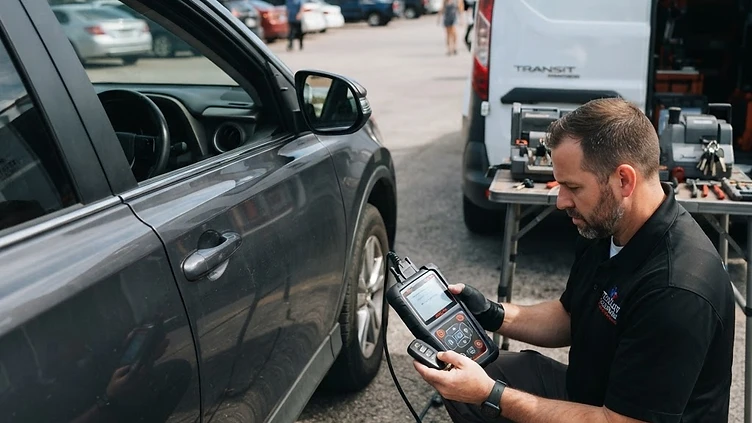
Also ask what they carry. A van that does car work should have long-reach entry tools, wedge and rod sets, a key cutting machine or a stock of blanks, and a diagnostic programmer. If they arrive with a coat hanger, send them away.
2. Licensing, insurance and proof-of-ownership checks
Texas requires locksmiths to be licensed through the Texas Department of Public Safety, and legitimate automotive locksmiths carry insurance covering damage to vehicles. Ask for the license number and confirm it; our guide to verifying a locksmith's license in Texas walks through it.
The best test is also the simplest: a professional will ask you for proof of ownership before cutting or programming a key. Your driver's license plus the registration, title or insurance document with the VIN. Anyone willing to make a car key from a VIN with no paperwork is a risk to you, not just to the last owner of that VIN.
3. A firm price before they touch the car
Ask for the total: service call, labor, key blank, cutting and programming. Ask specifically whether the price changes at night, on weekends or for a high-security key, because it often does and you want to hear it before dispatch.
A legitimate business will give you a range or a firm number on the phone. What you're guarding against is the pattern where a technician arrives, opens the car, and then announces a price several times the quoted figure. If the number changes on site, ask them to stop and confirm before continuing.
4. What happens if something breaks
Ask what their policy is if a window seal, door card, lock cylinder or trim is damaged during the work. A professional carries insurance for that and will tell you the process, typically documentation and a repair at their cost.
Also ask about the warranty on programming. A new key or fob should come with a warranty that covers a programming failure, and you should know whether they'll return if the fob stops working next week.
Red flags worth walking away from
- A quoted price dramatically below everyone else in the market.
- No physical address and no verifiable license number.
- Pressure to pay in cash only, before the work.
- Unwillingness to quote the total on the phone.
- No proof-of-ownership request on a key programming job.
- Arriving in an unmarked vehicle with no programming equipment visible.
What good service looks like on the day
A professional arrives in a marked vehicle, introduces themselves and confirms the quote before starting. They ask to see your ID and registration, look at the door and explain the technique before using it: long-reach tools or a wedge and rod, not a pry bar. Glass and seals are protected with a guard where needed.
If a key is being made, they test it in every lock and in the ignition before packing up, and they show you that the old key still works, or that it has been erased as requested. Payment comes with a receipt listing the work, the key type and the warranty. All of that takes a minute to observe, and it tells you immediately whether you are dealing with a professional.
When to call a pro
You need one whenever a key is locked in, all keys are lost, a fob stopped working, an ignition won't release the key, or a key needs programming. Those are not DIY jobs on a modern car: an attempted entry can bend a window frame, and an attempted programming can lock an immobilizer.
We do automotive work across Dallas, Fort Worth, Irving, Grand Prairie and Arlington, and you can see what's covered on our automotive page. For lockouts at 2am, our 24/7 service dispatches to your location.
FAQ
How do I verify an automotive locksmith is licensed in Texas?
Ask for the license number and confirm it through the Texas Department of Public Safety's online resources. A licensed business will give it without hesitation and carry liability insurance.
Should a locksmith ask for my ID and registration?
Yes, always, before cutting or programming a key. It protects you: without that check, anyone who copies your VIN could order a key to your car.
Can all automotive locksmiths program smart keys?
No. Capability depends on their diagnostic equipment and subscriptions. Ask before dispatch whether they can program your specific model year.
Is it cheaper to wait for a dealership?
Sometimes, if the car is already there and the dealership handles the model at a reasonable rate. But towing, scheduling and the day without a car usually outweigh the difference in an emergency.
Ask four questions, get four straight answers, and you've found a professional. Call DFW Key Master at (682) 666-2966 and we'll answer them all upfront.