Is There a Chip in My Car Key?
January 1, 2027 · DFW Key Master Team · 5 min read
Almost every vehicle built since the late 1990s carries a chip in its key, and the chip is usually invisible. That invisibility is why so many drivers discover the difference at the worst moment: a freshly cut copy that turns the door and refuses to start the engine.
Knowing what you have takes about a minute, and it changes what a replacement costs, who can make it and how long it takes.
What the chip actually is
The chip is a transponder, a small sealed component with no battery, sitting in the plastic head of the key or the body of the fob. It contains an identifier, and the vehicle's immobilizer reads it through a coil around the ignition or the push-to-start button.
If the identifier is not on the vehicle's list of accepted keys, the engine will not run. That is the entire security model, and it is why a key is no longer just a piece of shaped metal.
Our guide to types of car keys covers the broader family, and the ignition system explainer covers what the vehicle does with the signal.
Telling whether your key has one
Four practical checks, in order of reliability.
Look at the plastic head. A thick, sealed head with a visible seam or a small molded cap usually means a chip inside. A key that is thin metal all the way to a plain plastic grip is more likely a plain blade.
Look for a symbol. Some keys carry a small icon of a car with a padlock or a key, which indicates an immobilizer.
Check the dashboard. Turn the key to the run position without cranking, and look for a light shaped like a car with a key inside it. That light illuminates to indicate the immobilizer is reading the key, and its presence means the vehicle is chipped.
And the most reliable test: the model year. Anything built after the mid-nineties in the US market very likely has one, and anything with push-to-start certainly does.
The three families you will meet
A transponder key looks like an ordinary key with a thick plastic head and no buttons. The chip is passive, so there is no battery to change, and the blade is cut conventionally.
A remote head key is the same idea with lock, unlock and panic buttons built into the head. It has both a chip and a battery, and each can fail independently.
A smart key or proximity fob has no blade at all, or hides one in a slot. It talks to the car continuously, so the vehicle can be started with the fob in a pocket. These require pairing, and the pairing is what makes them expensive to replace.
What this means for copying
A plain blade can be duplicated anywhere: a hardware store, a kiosk, a locksmith. Nothing needs programming, because nothing is talking to the car.
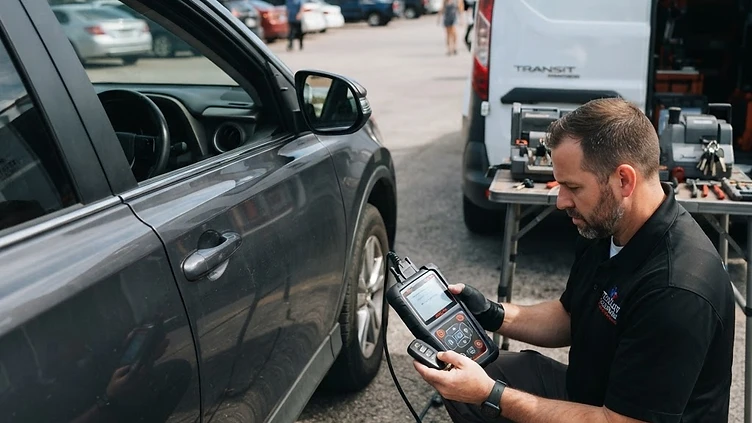
A chipped key needs two operations: the metal is cut to the correct profile, and the chip is registered with the vehicle. The second part is what turns a two-minute errand into a service call, and it is why a locksmith needs the car present.
The cutting also matters. Newer vehicles use side-milled or track keys that require a different machine than the one that copies an older edge-cut blade. Our article on why a copied key fails covers the mismatch case.
Cloning versus programming
There is a shortcut worth knowing about. Some chips can be cloned: a machine reads the existing key's identifier and writes it onto a blank that presents the same value. The vehicle cannot tell the difference.
Cloning is quick and inexpensive, and it has a real drawback. The car still believes there is one key, so if that key is lost or stolen, the clone is not a separate credential you can erase. The lost key and every clone of it remain valid.
Programming adds the new key to the vehicle as its own credential, which means it can be tracked and erased. For a spare kept at home, cloning is often fine. After a theft or a loss, programming and erasing is the only approach that actually changes anything.
Signs a chip is failing
The classic symptom is a car that cranks and does not start, with the immobilizer light flashing. Or a vehicle that starts for a second and dies. Or one that only starts when the fob is held against the button, which is the emergency position for a fob whose battery is dead.
A chip itself rarely fails. What fails is the battery in a remote head key or fob, the coil around the ignition, or the key's physical contact with the reader. Our push-to-start guide and the fob battery piece cover the common causes in order.
The keyless theft angle
A smart key's convenience has a cost: the fob broadcasts, and a relay device can extend that signal to a car parked outside a house. That is why the trade recommends a faraday pouch at home, or a fob stored at the far end of the house.
Our keyless theft guide covers the countermeasures, and the car door security piece covers the physical side.
Getting a chipped key made in DFW
Call with the year, make, model and VIN, and say whether you have one working key or none. That answer decides the process: adding a key to a vehicle that already has one is fast, while making the first key from nothing takes longer and costs more.
Ask whether the shop programs at the vehicle and whether it erases keys you no longer hold. Both are the difference between a real replacement and a copy.
When to call a pro
Call DFW Key Master at (682) 666-2966 for chipped keys, fobs and programming at your vehicle across Dallas–Fort Worth. Our automotive team covers the metroplex, and our transponder programming guide explains the electronics.
FAQ
How do I know if my car key has a chip?
Look for a thick sealed head, an immobilizer symbol on the dash that lights with the key turned on, or a push-to-start system. Model year after the mid-nineties usually means yes.
Can I copy a chipped key at a hardware store?
The metal can be copied almost anywhere. The chip has to be registered with the vehicle, which a hardware store cannot do.
Does a chipped key have a battery?
The transponder itself does not. A remote head key or fob does, and a dead battery is the usual cause of a key that stops working.
Why does my car crank but not start?
Usually the immobilizer is not accepting the key, which points to the chip, the battery or the reader coil rather than the starter.
A chip changes everything. Call DFW Key Master at (682) 666-2966.