Why Won't My Car Key Copy Work?
November 30, 2026 · DFW Key Master Team · 5 min read
A copied key that opens the door but will not start the car is the most common key complaint we hear, and it almost never means the copy was cut badly. It means the copy was made for the wrong part of the job.
A modern key is three things in one: a cut blade, a transponder chip, and sometimes a radio remote. Cutting a blade only satisfies the first. Here is the diagnosis, in the order worth checking.
1. The chip was never programmed
This is the answer the majority of the time. The key was cut at a hardware store from a blank that may or may not contain a chip, and nothing was written to it. The blade turns the cylinder, the door opens, and the immobilizer refuses to let the engine run because no valid chip answered its challenge.
How to tell: the car cranks and dies immediately, or does not crank at all, and a security or key symbol flashes on the dash. Some vehicles even show "key not recognised".
What fixes it: programming, which needs the right interface and the code for your vehicle. It is not a hardware-store service on anything built since the late 1990s.
2. The blank is wrong for the vehicle
The packaging says "transponder key" and the chip inside is the wrong type, the wrong frequency, or a blank that some vehicles simply will not accept. Cheap aftermarket blanks are a lottery on newer cars, and the failure looks identical to an unprogrammed key.
This is why our guide to duplicating a car key in DFW splits keys by type before talking about where to go.
3. The copy was cloned, and the car rejects clones
Some programming methods clone one key's identity onto another. Many vehicles accept that fine. Others detect two keys with the same identity and refuse one of them, or lock the immobilizer until a dealer or a locksmith clears it.
If a second copy worked for a while and then stopped, cloning is a real suspect.
4. The original key was already worn
The copy is cut from your working key, so it inherits its problems. If the original has a rounded tip, a burr along the cuts, or has been filed by hand, the copy may be cut from a worn profile and simply not sit at the right depth in the ignition.
How to tell: the copy works in the door but catches in the ignition, or works with a jiggle. The fix is to cut from a code rather than from the worn key, which any good shop can do.
5. It is a valet key, or a restricted-function key
Some keys are intentionally limited. A valet key opens the door and starts the car but will not open the trunk or the glovebox, and a valet mode on newer cars can restrict speed and storage access. If the copy behaves oddly rather than not at all, this is worth considering.
6. The vehicle has reached its key limit
Every immobilizer has a maximum number of keys it will hold, usually between four and eight. A car that has accumulated keys from three owners may be full, and a new key cannot be added until an old one is erased.
This is also why a used car with one key is worth sorting out early; our guide to buying a used car with one key explains the erasure step.
Test it in the right order
- Lock and unlock with the blade in the door. If that works, the cut is fine.
- Put the key in the ignition and turn to ON without cranking. Watch for the security light. A light that stays on or flashes is the immobilizer refusing the chip.
- Try the original key. If the original works and the copy does not, the problem is in the copy or its chip.
- Try a second copy. Two failures point at the vehicle, not the copies.
- Call with the specifics. Year, make, model, VIN, what the copy does and what the dash does.
What programming actually involves
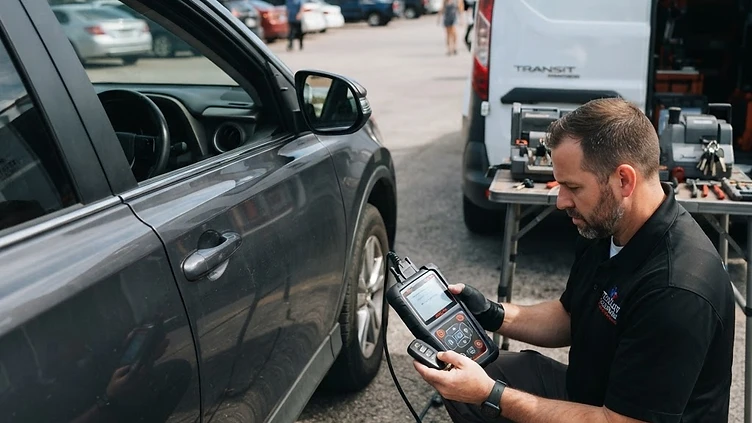
A technician connects a diagnostic interface to the OBD port, proves ownership, and writes a new key into the immobilizer's key table. On many vehicles that requires an existing working key or a security code. On a few, it requires an online dealer authorisation.
Our transponder programming guide covers the process, and our piece on types of car keys explains which type you are holding.
Why the cheap copy is not cheap
A hardware-store duplicate on a transponder key costs very little and gives you a key that opens a door and cannot start a car. It is not a spare; it is a door key.
A proper second key costs more, and it comes with the thing that matters: the ability to start the car on the morning you have lost the first one. That is the entire point of a spare.
When to call a pro
Call an automotive locksmith when a copied key will not start the car, when you want a working spare programmed, or when a key stopped working without being damaged. Bring the vehicle, the working key if there is one, and the registration. Our automotive team programs keys on site across Dallas–Fort Worth.
Call DFW Key Master at (682) 666-2966.
FAQ
Why does my duplicated key open the door but not start the car?
The blade is cut but the transponder chip is either missing or not programmed, so the immobilizer refuses it. Programming is a separate step with separate equipment.
Can a hardware store copy a transponder key?
It can cut the blade and sometimes clone a basic chip. On newer vehicles the clone is often rejected, and the store cannot program a new key properly.
Will programming a new key erase the old one?
Not automatically. Erasing old keys is a separate step, and it is worth asking for if a key has been lost or a car has had several owners.
Can you fix a copy that stopped working?
Usually by reprogramming or by cutting a fresh key from the vehicle's code rather than from the worn original.
Program the chip, not just the blade. Call DFW Key Master at (682) 666-2966.