Is It Common to Buy a Used Car with Only One Key Included?
December 1, 2026 · DFW Key Master Team · 5 min read
It is extremely common, and not a red flag on its own. Most used cars are sold with one working key and a story about the second one, and the story is usually true: it was lost years ago and nobody wanted to pay for a replacement.
The problem is not the missing key. It is what the missing key represents, and what the immobilizer thinks about it.
Why it happens so often
Fobs are expensive, so people delay. A second key gets quoted at a number the owner does not want to pay, and it goes on a list that never gets done. Then the car is sold with one key and a shrug.
The other version is less innocent: a used car from an auction, a repo, a fleet turnover or a lease return often arrives with whatever key happened to be in it. Nobody at the dealership knows where the others went, and nobody is going to pay to find out.
Why it matters more than people think
Three reasons.
You have no redundancy. A lost or damaged key with no spare is not an inconvenience, it is a tow or a same-day premium call. Our guide to losing your only key covers the worst case, and it always begins the same way: no spare.
The car may still recognise keys that are not in the sale. A key fob that was lost three owners ago may still be programmed to the vehicle. If it is in a drawer somewhere, it can open and start the car. That is the security problem nobody mentions in the listing.
The immobilizer has a key limit. Most vehicles hold between four and eight keys. A car with a long history may be full, so adding a new key requires erasing first, which is a different job with a different price.
How many keys does the car actually know about?
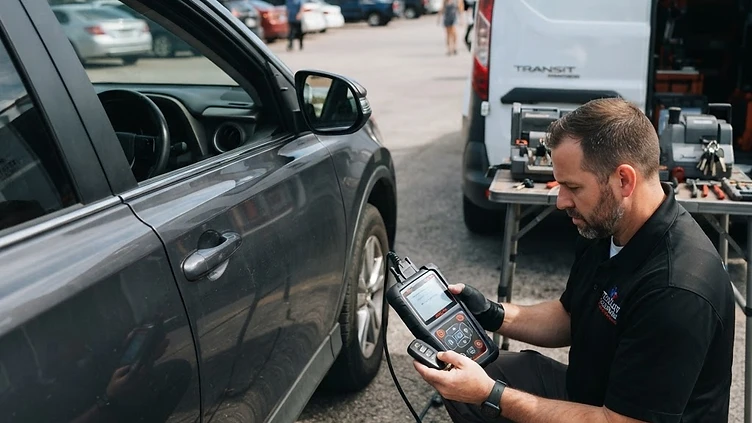
This is the question worth asking, and it is answerable. A diagnostic scan by an automotive locksmith can report the number of keys stored in the immobilizer. That number is the real history of the vehicle, not the number of keys in the cupholder.
If the scan says four and you have one, three unknown credentials can open the car. That is a straightforward reason to have the system cleared and fresh keys programmed at the start of your ownership.
Before you buy: four questions
- How many keys come with it? Get it in the listing, or in writing.
- Do both keys start the car? A key that only opens a door is not a key; see our piece on why a copied key won't start.
- Has any key been reported lost or stolen? Worth asking, and worth knowing for insurance.
- Is the fob intact? A cracked fob with a bag around it is a fob that will fail.
On a private sale, ask to test both keys yourself. It is a two-minute check and it occasionally reveals that the second key is a door key.
In the first week of ownership
- Have the key count read. If there are more stored keys than keys in your hand, clear them.
- Program two keys. Two is the minimum sensible number, and on many vehicles programming the second yourself with the first present is possible; on others it needs equipment.
- Erase unknown keys. This is the step people skip, and it is the whole point. Our fob replacement guide explains erasure and why it matters.
- Change the mechanical code if the car has a physical key cylinder. A rekey or new cylinder is cheap compared to the alternative.
- Check the keypad or PIN code, if the vehicle has one, and clear any stored personal settings.
The same logic applies to the garage remote on the sun visor, which a surprising number of buyers inherit; our piece on key fobs and access cards covers the credential side.
What it costs to fix, framed honestly
A second key ranges from inexpensive to genuinely painful depending on the vehicle: a plain metal key with no chip sits at the bottom, a transponder key in the middle, a smart key with a proximity fob at the top, and a handful of European models beyond that.
The number that matters is not the key price but the comparison: a second key now against a same-day emergency key plus a tow later. The second key is almost always the cheaper of the two.
It is also a negotiation point. On a used car with one key, ask for a second key as part of the deal. Dealers can often produce one; private sellers often knock something off.
One exception worth knowing
A very old car with a mechanical key and no immobilizer does not have these problems. A spare is a cheap cut at a hardware store, and the key history is irrelevant. Everything above applies to vehicles with a chip, which is nearly everything since the late 1990s.
When to call a pro
Call an automotive locksmith when a used car arrives with one key, when you want the stored key count read, or when you want unknown keys erased and two new ones programmed. Bring the registration and the vehicle, or have it where it is parked. Our automotive team covers Dallas–Fort Worth and can do the whole job in a driveway.
Call DFW Key Master at (682) 666-2966.
FAQ
Is one key a deal breaker on a used car?
No, but it is a cost to plan for. Budget for a second key and an erasure of stored keys, and use it as a negotiation point.
Can a dealer tell how many keys a car has?
Yes, with a diagnostic scan. An automotive locksmith can read the same information, and it is the only reliable answer.
Can an old key still start my car?
If it is still programmed to the vehicle, yes. Erasing stored keys is the fix, and it cannot be done from the keypad or the settings menu.
Should I buy a cheap fob online?
Only if you can get it programmed, and only if the vehicle accepts it. Many aftermarket fobs are rejected, and a cut key without programming does not start a car.
Read the key count before you celebrate the deal. Call DFW Key Master at (682) 666-2966.