The Steps a Locksmith Takes to Replace Lost Car Keys
December 22, 2026 · DFW Key Master Team · 5 min read
When every key to a car is gone, the job is not cutting metal. It is reconstructing a credential the vehicle will accept, from information the vehicle and the manufacturer hold.
The sequence below is what actually happens on a call, in order, and it explains both the price and why some jobs take twenty minutes while others take a day.
Step one: confirm the car is yours
Before anything is cut, the technician needs proof. Registration or title, plus photo ID. Company vehicles need a letter or an email from the company. A family member's car needs that person's authorization.
This is not a formality. A replacement key on an all-keys-lost job is the most valuable credential in the trade, and the checks are what stop it being made for the wrong person. Our guide to proof for a key lists exactly what to have ready.
Step two: identify the vehicle and the key
Year, make, model and VIN. The VIN is read from the dashboard or the door jamb, and it decides the key blank, the cut pattern and the programming route.
The technician is answering three questions. Is the key a plain blade, a transponder key, a proximity smart key or a fob with a hidden emergency blade? Is the blade cut with a standard edge or a side-milled track that needs a different machine? And does the vehicle need to be present for programming, or can the key be prepared from a code?
The answers vary by model year and trim, sometimes within the same model. That is why a phone call with the VIN is worth more than a guess.
Step three: obtain or cut the blank
The van carries common blanks and rarely carries all of them. If the right blank is on board, cutting takes minutes: by code where a code is available, or by reading the lock cylinder in the door or ignition.
If the blank is not on board, the job pauses here. That pause is a large part of the difference between a two-hour job and a next-morning job, and it is why calling early matters.
For a vehicle whose cylinder cannot be read easily, the technician may use the manufacturer's key code service, which requires the documentation from step one and sometimes a short wait.
Step four: program the key to the car
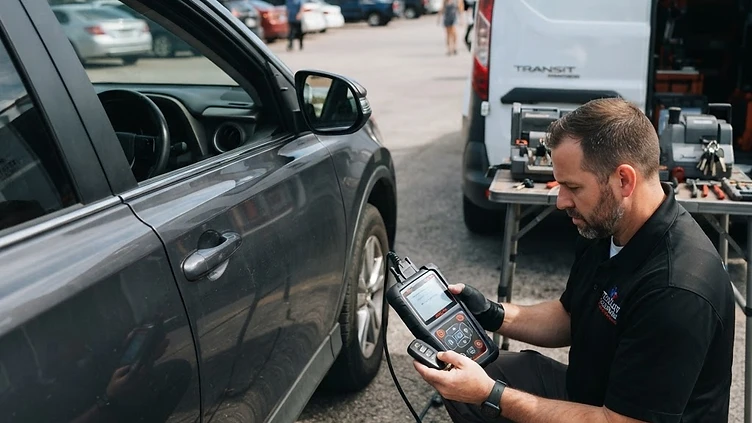
The blade turns the lock; programming is what lets the engine start. The technician connects a diagnostic tool to the OBD port, authenticates to the vehicle's security system, and adds the new key to the list of accepted keys.
On newer vehicles this authentication frequently goes through a manufacturer's gateway, which is why the tooling costs what it costs and why some models are dealer-only in practice.
A tip for the customer: this step needs the vehicle, so a key cannot be prepared entirely at a bench and couriered over. It also needs a stable battery, since programming on a low battery can fail or leave the vehicle in an odd state. If the car has been sitting, expect a battery check.
Step five: erase the keys you no longer have
This is the step customers forget to ask for and the one that matters most after a loss.
A vehicle's memory can hold several keys. Programming a new one adds it; it does not remove the lost one. Until the lost key is erased from that list, anyone holding it can start the car.
Proper erasure happens in the same session: the technician wipes the memory and then programs the keys you do have back into it. That is fast when all keys are already lost, since there is nothing to preserve, and slightly more involved when you have one working key.
Step six: test everything
Start the engine. Lock and unlock with the remote. Check the trunk or tailgate function, the panic button, and on a smart key the approach and push-to-start behavior. Check that the second key, if you had one, still works after the memory was rewritten.
This is where a rushed job shows up later, in a fob that locks but doesn't unlock, or a key that starts the car and can't open the door remotely.
Step seven: document it
A written invoice listing the key type, the number of keys programmed and the erasure of lost keys. It matters for insurance if the keys were stolen, and it matters for the next owner.
What can make the job stall
Four things. A blank that has to be ordered. A vehicle that requires online authentication the shop cannot complete, which becomes a dealer referral. A failed programming attempt caused by a weak battery, a bad aftermarket key or a fault in the immobilizer. And, on some vehicles, a missing or mismatched VIN record.
Being told one of these on the phone is not a brush-off. It is a real boundary in the trade.
How to make the call go well
Have the VIN, the registration and your ID ready. Say how many keys you still have. Say whether the car cranks and dies or does nothing at all, since that distinguishes a key problem from an immobilizer or starter problem.
Ask two questions when you book: will you program the key at the car, and will you erase the lost key in the same visit. Those two sentences filter out anyone who is only cutting metal.
Our walkthrough for losing your only key covers what to do while you wait, and the transponder programming guide explains the electronics.
When to call a pro
Call DFW Key Master at (682) 666-2966 for lost car keys, spare keys and fobs across Dallas–Fort Worth. We work at the vehicle, program on site and erase the keys you no longer hold. Our automotive team covers the metroplex.
FAQ
How long does replacing a lost car key take?
Often under an hour when the blank is on the van and the vehicle programs normally. Ordering a blank or a dealer-only authorization can add a day.
Will the lost key still start my car?
Only if it was not erased. Ask for the erasure in the same visit; otherwise a lost fob remains a working key.
Can a locksmith make a key if I have no key at all?
Yes, on most vehicles, by reading the cylinder or using the VIN and a code service, with proof of ownership.
Why does the car need to be present?
The immobilizer has to accept the new key. That handshake happens in the vehicle, not at a bench.
Cut, program, erase. Call DFW Key Master at (682) 666-2966.