All You Need to Know About Lock Picking
November 14, 2026 · DFW Key Master Team · 5 min read
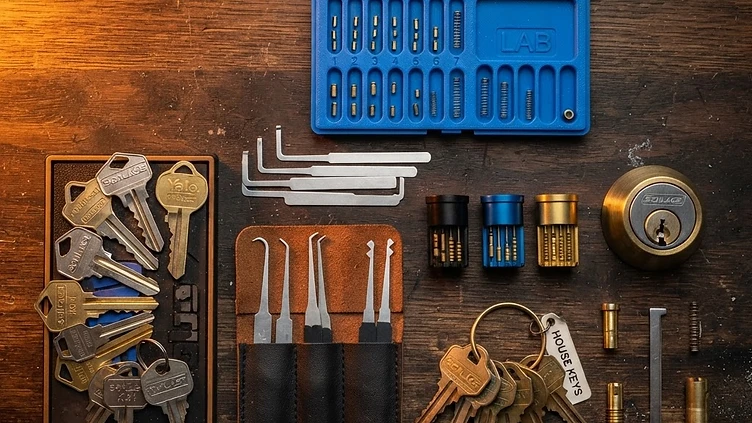
Lock picking has a strange reputation: part spy craft, part internet hobby, part magic trick. In reality it's a mechanical technique that relies on tiny manufacturing tolerances, and understanding how it works is useful even if you never touch a pick yourself.
This is an overview of the concept and the trade, not a how-to. If you're locked out of your own home right now, skip to the last section.
What picking actually is
A pin tumbler lock, the most common residential lock in Texas, contains a set of spring-loaded pins. When the correct key is inserted, each pin sits at exactly the right height. Picking is the craft of finding that same position without the key, by applying light rotational tension and working each pin individually.
It requires feel, patience and a lock with loose enough tolerances. It's quiet, it's slow the first few hundred times, and it's the reason locksmiths can open a door without damaging it.
Why locksmiths use it
When a customer is locked out of their own property, picking is often the least destructive option. Nothing is drilled, nothing is replaced, and the existing hardware stays functional. On a standard residential deadbolt or knob, an experienced locksmith can usually open the door in a couple of minutes and hand you back a working lock.
That's the whole point of the skill in professional practice: not bypassing security, but restoring access with the least damage.
The tools, broadly
Picks come in shapes for different keyways: hooks, rakes, diamonds, and tension tools that hold the cylinder turned slightly while you work. There are also non-picking bypass techniques that use the gap between a door and a frame, and there's bumping, which is a different mechanical trick entirely.
None of this appears in a household toolkit because none of it works reliably on a modern high-security lock. Which leads to the next point.
What picking can't do
A pick won't open:
- A thrown deadbolt from the outside, because the bolt is fully engaged and the cylinder is only part of the equation.
- A high-security cylinder with security pins, a sidebar or a restricted keyway. These are designed to frustrate exactly this.
- A smart lock or electronic lock with no mechanical bypass accessible.
- A padlock with a shielded shackle or a disc-detainer core, in most cases.
- A door that's locked and barricaded. No amount of skill changes physics.
This is why most locksmith calls end with a specific tool chosen for a specific lock, not a pick set and hope.
The legal line in Texas
Owning lock picks is legal in Texas. Using them on property you don't own or have permission to access is not, and the consequences are serious. Locksmiths in Texas are licensed through the Texas Department of Public Safety, and legitimately operating as one requires that license, insurance and proof-of-ownership checks on every job.
For a homeowner, the practical rule is simple: it's fine to be interested in the mechanics; it is not fine to attempt entry anywhere you can't demonstrate authority, including a rental you don't have permission to modify.
Why the videos mislead
A five-minute video makes this look easy because the camera sees a clean, well-used practice lock with soft tolerances, and the edit hides the attempts. Real doors have weather-beaten cylinders, worn pins, dirt, and hardware installed by somebody in a hurry ten years ago. The result is that hobbyists often spend an hour on a door that a professional opens in two minutes, and in frustration they try something that damages the lock.
What to do if you're locked out
Call a locksmith. If you're in an apartment, call your landlord or maintenance line first; many buildings have arrangements that are faster than a callout. If a child or pet is inside, call 911. And if a key is broken in the lock, don't keep working at it; extraction is a separate job that needs the right tools.
Our house lockout page lists what to have ready, and our comparison of when to call a pro versus DIY is an honest look at where the line sits.
When to call a pro
Call a licensed locksmith when you're locked out of property you own or rent with permission, when a key is broken off inside, when a lock has been tampered with, or when you want better hardware after a break-in. We don't teach picking, and we won't open a door for someone who can't show authority, but we will get you in with the least damage possible.
FAQ
Is lock picking legal in Texas?
Owning picks is legal. Using them to enter property you don't own or have explicit permission to access is not. Locksmiths must be licensed by the Texas Department of Public Safety.
Can a locksmith always pick a lock?
No. Thrown deadbolts, high-security cylinders, damaged locks and electronic locks often need other techniques, and sometimes drilling is the honest answer. A good locksmith explains which and why before starting.
Does picking damage the lock?
Done properly, no. That's why it's preferred over drilling. Forcing tools or using the wrong technique can bend pins or damage the cylinder, which is what happens when someone without training tries it.
Will a locksmith open a door for me without ID?
No legitimate one will. Expect to show a license with the address, a lease, or mail. It's the same reason a car key requires proof of ownership.
Skip the DIY attempt and the damaged lock. Call DFW Key Master at (682) 666-2966 when you're locked out of your own door.