How to Become a Licensed Locksmith in Texas
January 7, 2027 · DFW Key Master Team · 5 min read
Texas licenses locksmiths. That single fact shapes the whole route into the trade, and it is also the reason a customer should ask to see a license before letting anyone work on a door.
If you are considering the work, here is the sequence, from the paperwork to the years that actually teach it.
Understand what is being licensed
A locksmith business in Texas operates under the state's private security licensing framework, which covers the company and the individuals who do the work. There is a company-level license and an individual credential, and employees who handle the work are registered under the company.
What that means practically: you cannot simply print a phone number on a van and start opening doors. There is an application, a background investigation and a liability insurance requirement before you can legally trade.
Requirements, forms and fees are set by the state and change occasionally, so confirm the current figures with the licensing authority before you budget. Our license verification guide shows the same process from the customer's side, which is worth reading as the mirror image of this one.
The eligibility baseline
You need to be an adult with a clean enough record to pass a background investigation. Fingerprints are submitted, and the check looks at criminal history, including some categories that disqualify outright.
Honesty matters more than a perfect record here. Applications that omit an old charge are treated more harshly than the charge itself, and an appeal is easier before a denial than after one.
You will also need a valid driver's license and a reliable vehicle if you plan to work in the field, because the job is mobile by nature.
Insurance, which is not optional
A locksmith business carries general liability insurance, and the license requires proof of it. This is a cost that surprises new technicians: it is not a small annual bill, and it is why an unlicensed operator can undercut a legitimate one.
It is also the reason a customer should ask. Our buying guide touches the hardware side, but the coverage question is the one that matters when something goes wrong on a job.
The exam and the paperwork
Depending on the credential you are applying for, there is an application packet, a fee, fingerprints and, in some paths, an examination covering the trade and the law. Expect a wait of weeks rather than days between submission and a decision.
The company license also requires a designated manager or qualifier who meets the experience requirement, which is why many people enter the trade as an employee of an existing licensed business rather than starting their own.
The apprenticeship, which is the real education
No license teaches you to open a lock. The skill comes from volume: a year of openings, rekeys, key cutting and hardware installs under somebody experienced.
A good apprenticeship rotates you through all of it. Residential lockouts and rekeys first, because they are frequent and forgiving. Then hardware installation, then commercial doors, then the vehicle work if the shop does it.
What you are building is a pattern library. A technician who has seen four hundred jammed deadbolts diagnoses in thirty seconds what a beginner takes an hour to work out. Our article on the skills the job requires covers what to develop deliberately.
One thing to watch in an apprenticeship: if the shop only does one kind of work, you will only learn that one kind. Ask what a week looks like before accepting a job.
Tooling, accumulated rather than bought
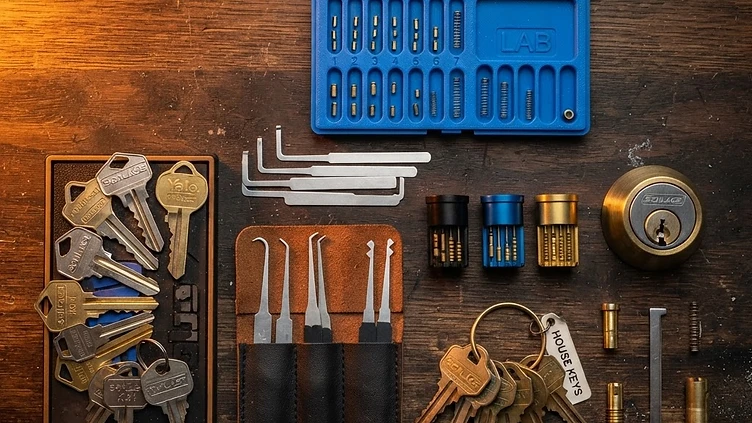
The tool list is long: picks, tension tools, key machines, code software, cylinder pins, a stocked van, and eventually diagnostic equipment for vehicles.
Nobody buys it all at once. The realistic pattern is that an employer provides the basics, and a technician adds specialty tools as they take on specialty work. Vehicle programming tools are the expensive step, and they are the reason automotive work is usually learned inside a shop that already does it.
Choosing a direction, sooner or later
The trade branches. Residential work is emergency-driven and customer-facing. Commercial work is systems work: master keys, access control, hardware for doors that take abuse. Automotive is electronics and diagnostics. Safes are their own niche.
Specialize when you have enough general experience to know what you like, and no sooner. A technician who has run all four for two years makes better decisions about which one to build a career on. Our career overview covers the long view.
Continuing education and the state of the trade
Hardware changes. Electronic locks, networked access control and vehicle immobilizers all demand ongoing learning, and a technician who stopped reading in 2015 is now limited to older work.
There are also trade associations and certification programs that go beyond state licensing, and they are worth the cost for anyone in commercial or high-security work, because they signal competence in a market where customers cannot assess it themselves.
Then the business side
If you intend to run your own operation, the licensing is the easy part. The hard parts are quoting accurately, keeping the van stocked, answering the phone at night, invoicing and collecting.
Our breakdown of how locksmith pricing works is the foundation of that half, and it is the half that decides whether a good technician makes a living.
A realistic timeline
Months for the application, fingerprints and insurance. A year or more of supervised work before you are genuinely useful on your own. Three to five years before you have a specialty and can choose between employment, a van of your own and a team.
That is not fast, and it is roughly how every skilled trade works. The trade-off is a licensed skill that travels, cannot be offshored, and gets a phone call at 2am.
When to call a pro
If you are hiring rather than training, check the license before the price. Call DFW Key Master at (682) 666-2966 for residential, automotive and commercial work across Dallas–Fort Worth. Our services overview explains the range.
FAQ
Do you need a license to be a locksmith in Texas?
Yes. Locksmith businesses and the people doing the work fall under the state's private security licensing framework, with an application and background check.
How long does it take to get licensed?
Weeks to months for the application, fingerprints and insurance. The trade itself takes a year or more of supervised work to learn properly.
Do you need insurance?
Yes, liability insurance is part of operating legitimately, and customers should ask for proof before work starts.
Is there a locksmith exam?
Some credential paths include an exam covering the trade and the law. Confirm the current requirement with the licensing authority.
License first, then learn the trade. Call DFW Key Master at (682) 666-2966.