What Are the Skills Required to Be a Locksmith?
December 27, 2026 · DFW Key Master Team · 5 min read
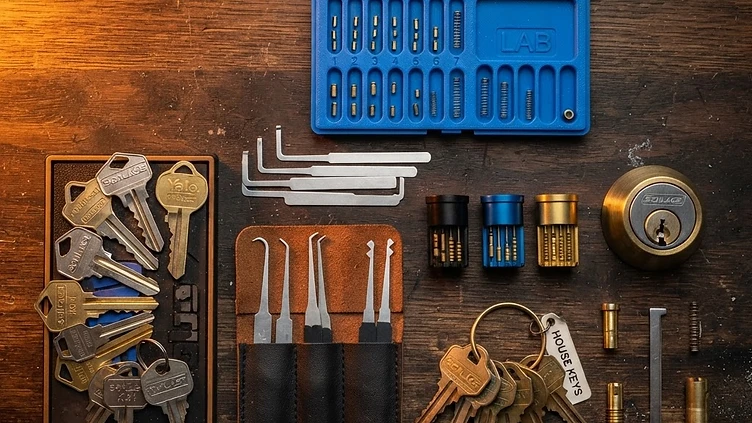
People picture locksmithing as a single skill: knowing how to get a door open. In practice the job is a stack of abilities that rarely appear together, and the technician who is strong in all of them is the one who stays in the trade.
Some of those abilities are mechanical, some are diagnostic, and a surprising number are about people. Here is what the work actually asks for.
Mechanical reasoning before hand skill
A lock is a small machine with a known logic: pins, springs, drivers and a shear line. Understanding that logic is what separates a technician who diagnoses from one who tries things until something works.
In practice this means being able to look at a cylinder and predict what will happen when a key is inserted, and being able to reason about why a bolt is not throwing even though the handle turns. The same instinct applies to a sagging door, a bent strike or a frame that has swelled in the summer heat, all of which cause lock failures that are not lock problems at all.
That reasoning transfers. A technician who understands one mechanism learns the next one quickly, which matters in a trade where hardware changes every few years.
Hands, and the patience to use them slowly
Locksmithing is fine work done in awkward places: a cylinder at arm's length, a car door at knee height, a safe dial in a corner. It rewards a steady hand and, more importantly, restraint.
The instinct of a beginner is to force. The instinct of a professional is to stop, reassess and try a different approach, because the cost of impatience is a damaged lock and an unhappy customer. Our article on locksmith techniques shows how much of the work is feel rather than strength.
Most of the job is short bursts of precision separated by longer stretches of thinking, which is a different stamina from the kind a laborer needs.
Electronics, which is now half the trade
A generation ago a locksmith needed a key machine and a pick set. Today's technician also needs to read a wiring diagram, use a multi-meter, configure a keypad, pair a fob, load a diagnostic tool and troubleshoot a network-connected lock.
Vehicle work is the clearest case. Programming a transponder key or a proximity fob is a software operation with physical consequences, and a technician who does not understand the immobilizer system will spend the afternoon guessing. Our transponder guide shows the depth involved.
On the commercial side it is access control: controllers, readers, credentials, timers and door hardware that all have to agree with each other.
Diagnostics, which is really pattern recognition
The most valuable skill in the trade is not opening locks. It is asking the right questions.
A homeowner says the lock is broken. The technician asks whether it happens with both keys, whether the door sticks in the afternoon, whether it changed after the season, whether anyone has painted the door. Within a minute the answer is often a misaligned strike rather than a failing cylinder, and the fix is adjusting hardware rather than selling a lock.
That pattern library is built from call volume. It is why experience commands a premium, and why an apprentice who watches a good technician for a year learns more than a manual can teach.
Discretion, which is not optional
A locksmith is handed access to homes, vehicles, businesses and safes. The ethical bar is high and it is tested quietly: the technician who declines to open a door for someone who cannot prove they belong there, who does not discuss a customer's keypad code in a group chat, who does not keep a copy of a key.
This is a professional skill, not a personality trait. It looks like a consistent process: documentation before work, an invoice after it, and no exceptions for a plausible story. Our guide to what proof a locksmith needs is that process written down.
The customer side, which surprises new technicians
You will explain the same three things a hundred times: why the lock needs replacing rather than repairing, why the key costs what it costs, and why the door cannot be opened without some damage. Doing that well, in plain language, without condescension, is a skill.
It also means being calm at bad moments. A person locked out at 11pm is embarrassed, a business owner whose storefront will not lock is frightened, and a parent whose child is in a hot car is panicking. The technician's job is to lower the temperature and then do the work.
Business sense, for anyone going out on their own
Most technicians eventually work for themselves, and the trade is unforgiving about the parts nobody teaches: quoting, scheduling, keeping a van stocked, invoicing, carrying insurance, tracking which keys belong to which job.
A technician who cannot quote accurately loses money on every job that runs long. Our piece on how locksmiths set their prices is the commercial half of the trade.
Physical and practical requirements
There is a floor. You need to drive, lift and carry tool bags, work in heat and cold, kneel on pavement and climb into tight spaces. Texas summers make a van without shade a genuinely hard workplace.
You also need a clean background, since customers are letting you into their property, and in Texas the trade is licensed through the state's Private Security program, which requires an application, fingerprints and a check. Our license verification guide explains the framework customers use to check it.
What you do not need
You do not need to be mechanically gifted from birth, tall, or young. There are excellent technicians who started in their forties after another career. You do not need a degree, and you do not need to have grown up fixing things.
What you cannot skip is the willingness to learn continuously, since hardware and vehicle electronics change faster than any curriculum.
How the skills stack up over a career
The first year is repetition: openings, rekeys, key cutting, the van, the paperwork. Years two and three add diagnostics and specialty hardware. After that the trade branches, into automotive electronics, commercial access control, safes, or owning a business.
Each branch rewards the same foundation: careful hands, clear reasoning, and a habit of doing the documented thing rather than the convenient one.
When to call a pro
If you are hiring rather than training, the skills above are what to look for. Call DFW Key Master at (682) 666-2966 for residential, automotive and commercial work across Dallas–Fort Worth. Our services overview explains what the trade covers, and our myths piece clears up what it does not.
FAQ
Do you need a license to be a locksmith in Texas?
Yes. Locksmith work falls under the state's private security licensing program, which requires an application, fingerprints and a background check.
Is locksmithing hard to learn?
The basics come quickly; diagnosing unusual hardware and programming vehicles takes years of volume. Most of the skill is pattern recognition.
What subjects help in school?
Nothing specific is required. Metalwork, electronics and any customer-facing job all help, and math matters for measuring and quoting.
Can you be a locksmith without being strong?
Yes. The work needs precision more than force, though you must be able to carry tools, drive long distances and work outdoors.
Careful hands, clear thinking. Call DFW Key Master at (682) 666-2966.