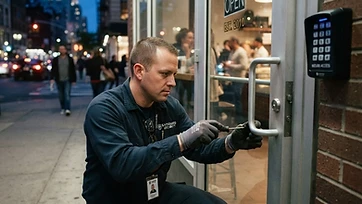
Top Smart Locks for Commercial Use in 2026
January 9, 2027 · DFW Key Master Team · 5 min read
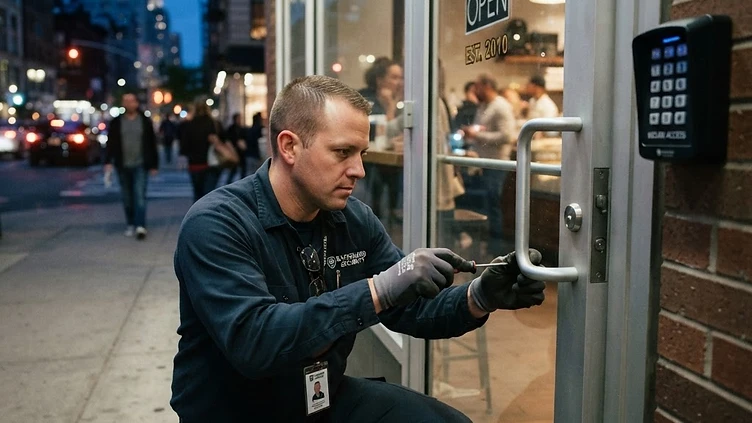
Commercial smart locks have quietly become the default for small businesses in Dallas–Fort Worth, mostly because they solve a problem keys cannot: revoking access in a minute instead of a rekey.
But the category is confusing, because three different products are sold under the same name. Choosing badly means a lock that fails an inspection, or a system nobody can administer six months later.
Three products, three jobs
A standalone electronic lockset keeps its own credential list on the door. No wiring, no hub, no software beyond a programming step. It suits a storage room, a supply closet, a single suite entrance, or a building where running cable is impractical.
The trade-off is management: a hundred standalone locks with a hundred separate programming routines is a part-time job nobody wants.
A wireless lock talks to a hub, so codes and audit logs flow to a dashboard. That is the practical middle for a small office with four to ten doors and a manager who wants to see who came in.
A networked access control system puts a reader and controller on the door, often with an electric strike or mag lock. Expensive, wired, and the only option when you need integration with an alarm, a time-clock or a parking gate. Our access control guide covers scoping one realistically.
The specification that matters most: egress
On any door a person uses to leave a building, the hardware must allow free exit at all times, without a key, a code or a special knowledge. That is a life-safety rule, not a style preference.
Practically, it means a lever handle that always opens the door from inside and, on a mag lock, a request-to-exit device plus a connection that releases on fire alarm. A smart lock that can be configured to hold someone in is a lock that will eventually be configured to hold someone in.
Electronic locks also need a fail-safe or fail-secure decision made deliberately, by door, with the fire marshal's expectations in mind. Our electronic locks overview covers the trade-off.
What a business should check before buying
Start with the audit trail. A commercial lock that records who opened which door, and when, is worth more than one that only unlocks. This is the feature that pays for the system after the first disputed delivery or missing laptop.
Then credential capacity and the management model. How many users, how many doors, per-door schedules, holiday calendars, and whether a code can be issued for a single visit and expire on its own.
Then the physical details: a lever rather than a knob for ADA compliance, a fire rating if the door is rated, an ANSI/BHMA grade matching the traffic, and a weather rating if the door faces outside. Our quality hardware guide explains the grading.
Finally, battery or power. A battery lock on a door used two hundred times a day is a maintenance item, and the failure mode is a building that will not open. A wired lock is more work up front and fewer surprises later.
Where each option fits in a DFW business
An office suite with a shared main entrance: a wireless lock on the suite door, with the building's own lobby access left alone. This is the most common install we do.
A clinic or dental office: networked access with an audit trail, because patient areas and narcotics storage are the kind of rooms where a record matters. Add a mechanical override on a keyed cylinder, held under a documented key control policy.
A warehouse or shop: a standalone electronic lock on the office door, and mechanical hardware on the roll-up doors, which electronic locks do not suit. A gate or yard entrance stays on gate hardware, covered in our security gates guide.
A multi-tenant building: the master key question arrives quickly. Electronic credentials and mechanical master keys solve the same problem differently, and many properties run both. Our master key guide covers the mechanical side, and our piece on mechanical versus electronic locks compares them honestly.
What smart locks do not fix
They do not strengthen a weak door. A hollow frame, a short strike screw and a glass panel beside the handle defeat a perfect credential system in seconds. On a commercial door the frame and the closer matter as much as the reader, which is why our high-security install guide starts with the opening.
They do not administer themselves. Somebody has to own the system: add users, remove them, change schedules, replace batteries, update firmware. A system nobody owns becomes a building full of doors nobody can open.
And they do not survive a proprietary vendor disappearing. Ask, before purchase, whether the locks work with a standard credential format and whether another local company can service them.
The 2026 trend that actually matters
Mobile credentials: a phone instead of a card. They are genuinely convenient and they remove the cost of physical cards, which is real for a business issuing dozens a year.
What to watch is the fallback. If the phone is dead, or the app is uninstalled, there has to be a documented way in. Every mobile-credential rollout we see needs a mechanical override on a keyed cylinder, held under key control.
How to buy without regret
Pilot one door for thirty days: the busiest one, or the one where the pain is worst. Measure how often it is used, how often the battery needs attention, and how often somebody cannot get in.
Then decide whether to roll out. That is cheaper than discovering after twelve doors that the app does not do the one thing the manager needed, and our commercial services overview covers what installation involves.
When to call a pro
Call DFW Key Master at (682) 666-2966 to specify, install and service commercial electronic locks across Dallas–Fort Worth. We fit the door first, then the credential. Our commercial team handles suites, clinics, warehouses and multi-tenant buildings.
FAQ
Are smart locks suitable for a commercial door?
Yes, for suite entrances, offices and interior doors, provided the lock meets egress, ADA and fire requirements and the door itself is sound.
What is the difference between standalone and networked locks?
A standalone lock keeps its own user list on the door. A networked system centralizes users and audit logs, at the cost of wiring and administration.
Do commercial smart locks need a key override?
Most installations should have one on a keyed cylinder, held under key control, so a dead battery or network failure does not lock a business out.
Can a smart lock be used on a fire-rated door?
Only hardware rated for that door, installed without compromising the door's rating. Check before buying, not after.
Pilot one door first. Call DFW Key Master at (682) 666-2966.