Top Security Issues in Old Buildings
December 6, 2026 · DFW Key Master Team · 5 min read
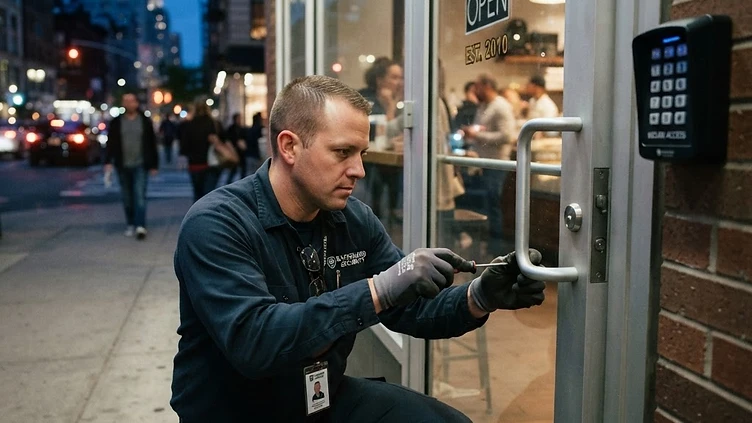
An older building is not less secure because it is old. It is less secure because it has accumulated problems, one tenant at a time, and because the standards it was built to were different from the ones now expected.
Here are the issues we find most often in commercial buildings across Dallas and Fort Worth, in rough order of how much they matter.
1. Doors that no longer fit their frames
A building settles. Frames go out of square, hinges wear, and doors that once latched cleanly now close on a shoulder. Thirty years of that produces a door that is technically locked and functionally openable with a pry bar at the latch side.
This is the highest-value item on the list because it defeats every lock on the door. A deadbolt holds the door to the frame; if the frame has a quarter inch of play, the bolt isn't the weak point, the gap is.
The fix is unglamorous: adjust or replace hinges, re-hang the door, repair the strike, and reinforce the jamb. Our guide to reinforcing a door frame covers the residential version; the commercial principle is identical. Our commercial door work is in repair and maintenance.
2. Obsolete cylinders and skeleton keys
Older buildings often carry hardware from an era of warded locks, skeleton keys and master-keyed systems designed before anyone thought about key duplication.
A warded lock is a lock you open with a bent piece of wire, regardless of the key. A skeleton key works on every lock in its series. And a cylinder from 1970 may accept a key cut to a code that half the neighborhood could obtain from a hardware store.
If a building still has skeleton-key hardware, replacing it is the only remedy, because there is nothing to rekey. Our guide to how keys get copied explains the modern version of the same problem.
3. Exit hardware that predates the code
This is the item that should worry you most, and it is not about theft.
Older buildings frequently have exit doors fitted with padlocks, chains, drop bars or deadbolts that cannot be opened with a single motion from inside. In a fire, that is the difference between a fast evacuation and a tragedy, and it is the reason modern code is strict about exit devices.
Our piece on how a panic bar works explains the mechanism and why it is specified by code, and our commercial team handles panic bar installation. If a door is chained shut to stop after-hours entry, that chain is a code problem, not a security measure.
4. Glass, transoms and windows that can be reached through
A storefront of single-pane glass, a transom above the door, a side window beside a lock: all of them make the lock irrelevant if a hand can reach through or an arm can be inserted.
Older buildings also have double-hung windows with painted shut locks, or no locks at all. The practical fixes are laminated glass or security film on the exposed panes, and secondary locking hardware on anything operable. A double-cylinder deadbolt helps on a glass door, provided the key is accessible from inside for egress, which is exactly where these installations usually go wrong.
5. Key control with fifty years of copies
A building that has housed six businesses and four landlords has an unknown number of keys in circulation. Nobody has a key schedule, the cylinders have been rekeyed at random, and the fire panel and the riser room may share a key with the mailroom.
This is the one problem that a locksmith solves with paperwork as much as hardware. A written key schedule, aligned cylinders and restricted keyways for sensitive areas are what turn chaos into something you can administer. Our guide to choosing a master key system covers the design, and our commercial services cover the audit.
6. Basement, roof and service entrances
Upper floors and back doors are where old buildings leak security, figuratively. A roof hatch with a rusted lock, a basement door behind a dumpster, a fire escape that has become a ladder, a service corridor shared with a neighboring tenant.
Walk the building with a list. Anything that opens into your space counts, including the hatch nobody has checked since the HVAC company stopped using it.
7. Retrofitting access control into old wiring
An owner wants card access; the building has a 1970s intercom, no conduit, and a door frame that can't take an electric strike without surgery.
This is solvable, but it needs a survey rather than a shopping list. Some doors accept a strike and a request-to-exit device easily; others need a frame replacement or a wireless lock. Our access control overview and the common mistakes piece cover the failure modes, and the biggest one is a system installed without thinking about how people get out.
8. Lighting and sightlines
A legacy factor that is cheap to fix and constantly overlooked. A dark loading dock, an overgrown parking strip, a stairwell with a broken light: these are where an old building invites the wrong attention. Motion lighting and a camera at the rear entrance are inexpensive compared with the alternative.
Where to start, in order
Fix the exit devices first, because that is life safety, not security. Then correct the doors that don't fit their frames. Then address the obsolete cylinders and the unknown key situation. Then glass, then access control, then lighting.
That order is not the cheapest; it is the one where the biggest risks get closed first.
Code, landlords and documentation
In a leased space, some of this is the landlord's work and some is yours. Exit hardware and the building shell usually belong to the owner; your suite's doors and keying are usually yours. Put the split in writing, and close the job with a written inventory of doors and hardware, because that document is what a future insurer or inspector will ask for.
When to call a pro
Call a commercial locksmith for a door-by-door survey of an older building, for exit hardware that may not meet code, and for a key system that nobody can account for. We work on both sides of a lease, and we produce the paperwork. Our commercial team covers Dallas–Fort Worth, and our office building guide covers the wider plan.
Call DFW Key Master at (682) 666-2966.
FAQ
What is the biggest security problem in an old commercial building?
Exit doors that don't meet code, and doors too out of square to latch properly. The first is a life-safety issue, the second defeats every lock on the door.
Can old skeleton-key locks be rekeyed?
Usually not. Warded hardware has no pin system to change, so the lock has to be replaced with a modern cylinder.
Are chains and padlocks allowed on exit doors?
No. A door serving as a required exit must open with a single motion, without a key or a tool. Chains are a code violation and a serious hazard.
How often should a building's key system be audited?
Every time occupancy changes materially, and on a schedule for multi-tenant buildings. An undocumented master key system is a liability.
Close the life-safety risks first. Call DFW Key Master at (682) 666-2966.