Common Problems With Automatic Door Locks and How to Deal With Them
October 19, 2026 · DFW Key Master Team · 5 min read
Power door locks are one of those features nobody thinks about until one door stops responding and the whole system goes strange. The good news: the failures are repetitive, and most of them fall into a handful of causes.
Here's the map, symptom by symptom.
How the system is put together
A power lock system has four parts: the lock actuator inside each door, the switch (usually in the driver's door and on each door panel), the wiring that runs through the flexible boot between the door and the body, and a control module or body computer that coordinates the locks.
That layout explains the behavior. One door failing is usually an actuator or that door's wiring. All doors failing is usually a module, a fuse or a shared ground.
Symptom: one door won't lock or unlock
The classic. The other doors respond, the switches click, and one door does nothing or makes a weak buzzing sound.
That's almost always the actuator in that door. The motor inside wears out and can't drive the latch. Sometimes you'll get partial function, like it unlocks but won't lock, because the motor is weak in one direction.
Replacing an actuator means removing the door panel, which is a shop job on most modern vehicles, and it's often the same labor as a window regulator repair. If a window regulator is failing on the same door, do both.
Symptom: all doors stopped working
Check in this order: the fuse, the relay, the driver's door switch, then the body control module.
A blown fuse usually means something downstream is drawing too much current, so replacing the fuse and stopping there may just blow the next one. The switch is a common culprit because it's used constantly and lives where coffee and dust land.
If the locks work from the fob but not from the interior buttons, the switch or its wiring is the problem, not the actuators.
Symptom: the locks cycle on their own
Lock, unlock, lock, unlock, sometimes for minutes. Annoying at 6am and eventually a dead battery.
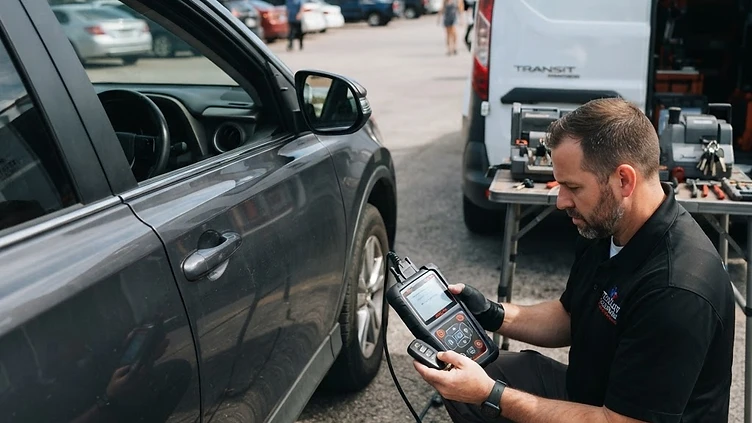
This is usually a door-ajar switch or a damaged wire in a door boot telling the module a door is open, so the system keeps re-locking. Water intrusion in a door or a corroded connector causes the same cycle. It's a diagnosis job rather than a parts swap; a scanner that reads body codes saves hours.
Symptom: the locks lock themselves with the keys inside
Some vehicles have an auto-lock feature that engages when the vehicle reaches a set speed, when the doors close after the ignition is switched off, or when the lock button is pressed while a door is open. Combined with a key left in the cabin, that's a lockout with no one to blame but the programming.
What to do:
- Check every other door; some systems leave the driver's door unlocked with the fob inside.
- If you have a spare, get it. In a keyless car, keep the spare fob at home, not in the vehicle.
- Otherwise call a mobile locksmith rather than prying a door.
Then change the behavior: many vehicles let you disable auto-lock in the settings menu, and it's worth doing if you often leave a bag on the seat.
Symptom: it locks but the door won't open
If the latch releases from outside but not inside, suspect the interior handle cable or the child lock. If neither opens it, the latch is stuck or the actuator is jammed mid-travel. Don't force the handle; that's how the linkage bends. Our car lockout guide covers what to do while you wait.
Symptom: buzzing or clicking from inside the door
A buzzing actuator is a worn motor or a stripped gear. It'll work intermittently for a while and then stop entirely. Not dangerous, but replace it before winter; cold weather makes weak actuators fail more often.
Symptom: only the fob works, not the buttons
Or the reverse. The fob path and the button path meet at the module but use different inputs. Fob only means the interior switches or their wiring; buttons only means the fob, its battery or its pairing.
Start with the fob battery, then the door switch. Those two cover most cases and cost the least.
When to call a pro
Call us when the locks leave you outside the car, when the key is inside and no spare exists, or when a door won't open from the outside at all. Locksmiths handle the access side; a shop handles actuator replacement. If the vehicle is a fleet or work truck with several doors misbehaving, it's worth a diagnostic visit rather than chasing parts.
Our automotive team covers lockouts and key programming across Dallas, Fort Worth, Irving, Arlington and Grand Prairie, day or night.
FAQ
Why do my automatic door locks lock by themselves?
Either an auto-lock feature is enabled, or a door-ajar switch or damaged wire is telling the module a door is open. Check the vehicle settings first, then have the body codes read.
Can I disable auto-lock on my car?
On many vehicles, yes, through a settings menu or a sequence in the owner's manual. It's worth doing if it has ever locked you out.
Is a broken power lock actuator expensive to fix?
Labor dominates on most vehicles because the door panel has to come off. Doing it alongside another door repair on the same door saves the cost of opening it twice.
Will a locksmith fix the actuator?
Most locksmiths handle entry, keys and lock cylinders, not power-lock actuators. If a door won't open at all, start with a locksmith for access, then a shop for the repair.
Keep a spare fob and know your auto-lock setting. Call DFW Key Master at (682) 666-2966 if you're locked out now.