How Does a Locksmith Make Keys?
December 10, 2026 · DFW Key Master Team · 5 min read

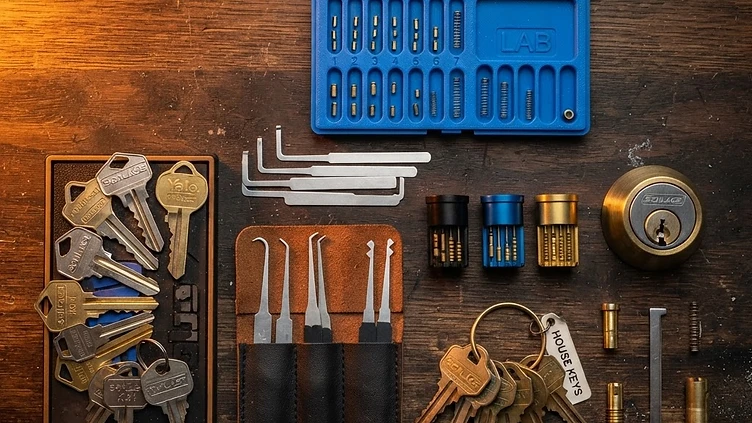
A key looks like a piece of stamped metal, but producing one that opens a specific lock requires either the original, the lock itself, or the code that made it. Those three sources define the five methods a locksmith actually uses.
Here is each method, how it works, and what it costs you in time and money.
First, the blank
Every method starts with a key blank: the uncut piece of metal with the right blade shape, thickness, groove pattern and shoulder geometry. The grooves, called the keyway or milling, are what let the blank enter the cylinder at all. Two keys can look similar and be useless in each other's lock because the milling differs.
Professionals identify blanks by the manufacturer and keyway rather than by eye. A domestic deadbolt from a hardware chain is one family; a European profile cylinder is several others; a vehicle is a third, and a vehicle with a side-milled or laser-cut track key is a fourth.
If the blank does not exist, nothing downstream works. That is why an antique or imported lock can take a week and an ordinary house lock takes ten minutes.
Method one: duplication from an original
The simplest case. You hand over a working key, the locksmith clamps the original into a duplicator and a blank into the other side, and a follower traces the original's cuts onto the copy.
This is what happens at the counter, and it is fast. Its weakness is inherited error: every generation of copy reproduces the wear of its parent. Copy a heavily worn key three times and the third is a key to nothing. If a key has been working for twenty years, a locksmith will often measure it rather than trace it, and cut a fresh key to the original depths.
A second nuance: a duplicate gets the cut depth right but not the key's chip. For a transponder key, duplication produces a blade that turns the cylinder and does not start the car.
Method two: cutting by code
Every production lock is built to a code, a string of numbers describing the depth of each cut. It's stamped on the plug or the cylinder body, recorded on the original key's packaging, or held in a manufacturer's database.
With the code, a locksmith cuts a key on a code machine without ever seeing the lock, which is precise and produces a key as good as the factory original. This is how a car key is made from a VIN through a dealer or an authorized lock shop, and how a house key is recreated after the only copy is lost.
The limiting factor is authorization. A code-cut key is a master key to a specific lock, so the trade expects proof that you own the thing: registration for a vehicle, a title, a lease or a closing document for a property.
Method three: reading the lock
If there is no key and no code, the lock itself is the source. The locksmith removes the cylinder, and either reads the pin heights from the plug or progressively turns each pin to the shear line and notes the depth.
On a house lock this is routine: disassemble, measure, cut, reassemble, test. On a vehicle it is harder, because the ignition cylinder often cannot be removed without opening it first, which is where the next method comes in.
Method four: impressioning
Impressioning is the craft technique: a blank is inserted, turned under tension, and the pins mark the blank where they bind. The locksmith files those marks, tries again, and repeats until the key turns. A skilled hand can impression a lock in ten to twenty minutes. A beginner will ruin a dozen blanks.
It exists because sometimes you cannot disassemble the lock and cannot obtain a code: an antique lock with no markings, a vehicle where the cylinder is inaccessible, a piece of furniture where taking it apart means destroying it.
Impressioning produces a key from the lock itself with no damage, which is why it is the preferred route on anything valuable or irreplaceable.
Method five: programming the electronics
On any vehicle built in the last twenty-five years, the metal is half the job. The other half is teaching the car to accept the key's transponder chip, or pairing a proximity fob to the body control module.
This needs a diagnostic tool that can talk to the specific make and model, an authorization step through a security gateway on newer vehicles, and the vehicle present. It also needs a plan for the keys you are not holding: the lost one should be erased from the car's memory at the same time, or it remains a working key to your car.
Our transponder programming guide and fob programming walkthrough cover that side in more detail.
What changes the price
Four things move the number, and none of them is the locksmith's mood.
The blank is the first. A common brass house blank costs almost nothing; a side-milled vehicle blank with an integrated remote can cost more than the labor.
The source is the second. Duplicating an existing key is the cheapest method. Code cutting needs a database and authorization. Impressioning needs skill and time. Reading a lock requires disassembly.
Programming is the third: the tooling and software licenses for vehicle work are a real operating cost, which is why a transponder key costs more than its identical-looking metal twin.
And urgency is the fourth. A key cut at a bench on a Tuesday and one produced at 2am on a roadside are the same key and different jobs.
What should never vary is whether you were told the number before work started. A firm quote on the phone is standard practice in this trade, and you can read more about that in our piece on finding a reliable locksmith.
What you should bring
For a house key, proof you live there or own it, plus the key if you have one. For a car key, the registration or title and your ID, and ideally the VIN. For a business, whoever can authorize the work.
A locksmith who does not ask for any of this is one to walk away from, and not only because of the price.
Duplicates you can trust
Two rules cover most households. First, never rely on a third-generation copy: when a key is old and worn, ask for a new key cut to the original depths rather than traced from the worn blade. Second, when you have a key made, have the spare cut at the same time and store it away from the first, which our key organization guide expands on.
When to call a pro
Call DFW Key Master at (682) 666-2966 for keys with no original, keys cut by code, keys for a car with no spare, and keys that need programming to the vehicle. Our automotive team works across Dallas–Fort Worth, and our locksmith techniques piece covers the non-key side of the trade.
FAQ
Can a locksmith make a key without the original?
Yes, by reading the lock or cutting from the manufacturer's code, with proof of ownership. For a vehicle, from the VIN through an authorized channel.
How long does cutting a key take?
A duplicate is minutes. Cutting by code is usually under an hour. Impressioning an antique or a vehicle cylinder can take longer.
Why is a car key so much more expensive than a house key?
The blank carries a chip or a remote, and the key has to be programmed to the vehicle with licensed diagnostic software.
Can every key be copied?
No. Some high-security and restricted keyways require authorization from the system owner, and some electronic keys cannot be cloned at all.
Give us the lock or the code, we'll cut the key. Call DFW Key Master at (682) 666-2966.