Breaking-and-Entering Methods Thieves Use (and How to Stop Them)
October 10, 2026 · DFW Key Master Team · 5 min read
Burglary is a trade with a short learning curve. Most residential break-ins happen in daylight, last a few minutes, and use one of about six entry methods. That predictability is useful, because each method has a matching countermeasure.
This isn't a how-to. It's the pattern, and the specific hardware and habits that make each one slower, louder or pointless.
Forcing the door
The most common method, and the least sophisticated: a shoulder, a boot, or a pry bar against the frame. The goal is to split the frame or tear the strike plate out of the trim, not to defeat the lock mechanism itself.
What stops it: a deadbolt with a full one-inch throw, a reinforced strike plate secured with screws long enough to reach the studs, and a frame that isn't just soft pine trim. A door that gives at the strike is a door with no lock, regardless of the cylinder inside it.
Our guide to reinforcing a door frame covers the specific parts. It's the highest-value dollar per minute of protection in a house.
Picking and bumping the cylinder
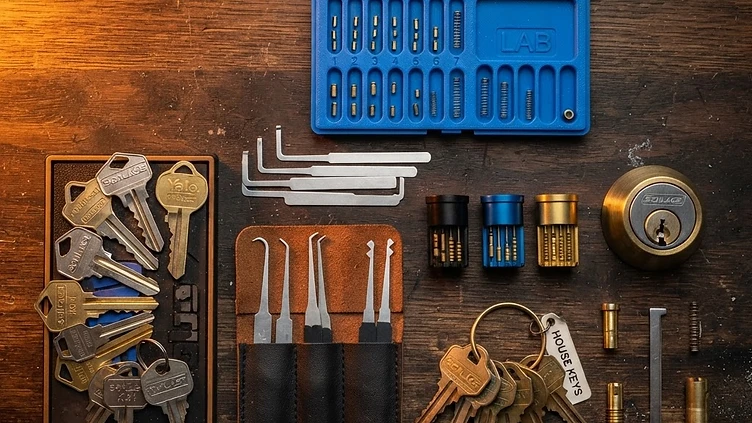
Quieter, less common, and heavily represented on the internet. Bumping uses a specially cut key struck into the cylinder; picking uses tools to lift pins. Both rely on a standard cylinder with loose tolerances.
What stops it: a high-security cylinder with security pins, a restricted keyway, or an anti-bump design. These cost more, and they're the correct choice on a front door that isn't visible from the street. For most homes, the frame reinforcement above matters more than an exotic cylinder; do both on the primary entry and the cylinder on the rest.
Drilling and snapping the lock
A destructive attack on the cylinder, fast and noisy. Snapping breaks the cylinder at a designed weak point and is why some European hardware failed badly in the 2010s.
What stops it: hardened steel cylinders, security escutcheons that shield the plug, and hardware rated for the attack. On a door with glass, none of this matters; see the next section.
Going through the glass
The weak point of any door with a window, a sidelight or a decorative panel: break the glass, reach in, turn the thumbturn.
What stops it: a double-cylinder deadbolt (key on both sides) on a door with glass, which requires a key left in the lock inside for fire safety. That's a real trade-off; a key in the lock defeats the purpose, and no key is a hazard in a fire. The alternative is laminated or security film glazing, which holds glass together and makes the reach-in much harder. Many DFW homes with big decorative sidelights use film plus a keyed deadbolt and a key on a hook out of reach of the glass.
Lifting a sliding door
Sliding glass doors can be lifted off their track from outside, or the latch can be slipped with a thin tool.
What stops it: a charley bar or a dowel in the track for the sliding panel, plus a secondary pin or a lock at the top of the frame, and screws in the upper track to prevent lifting. Replacing the latch alone rarely fixes the problem.
The garage door hook
The emergency release on a garage door opener can be hooked from outside with a wire through the top panel gap, which disengages the door and lets it be lifted by hand. It takes seconds and it's a known technique.
What stops it: a zip tie or a metal clip around the release trolley so the hook can't catch it, a solid or frosted top panel, and a deadbolt on the garage-to-house door. That interior door is the one that actually protects the house; many are hollow-core with a builder-grade knob.
Windows
Pried open, smashed, or reached through when left unlocked. Ground-floor windows at the rear are the usual target.
What stops it: working window locks on every operable window, pins or stops that limit opening to a few inches, and thorny planting below ground-floor windows. On older DFW homes with single-pane aluminum windows, the latch is often broken and nobody notices. Fix those first.
Fishing through the mail slot
A hook through a mail slot or a gap can reach keys hanging inside the door, or a thumbturn.
What stops it: no keys within reach of a slot or glass, and a slot with a cage or a solid interior flap. This is also why the key hook by the front door is worth moving.
The method that beats all hardware: an open door
A large share of residential burglaries involve an unlocked door, an open window or an open garage. That's not a statistic to feel bad about; it's the cheapest improvement available.
Make it habit: doors locked even when you're home, garage closed when you're in the back yard, windows closed when you leave.
Don't overdo it
Two things to avoid. First, don't barricade or chain a door that has to open in an emergency, especially in a house with children or older adults. Second, don't create a locked-in situation with a double-cylinder deadbolt and no key nearby.
Security that traps you is not security.
When to call a pro
Call a locksmith to evaluate your entries and prioritize the fixes: a strike reinforcement, a high-security cylinder on the exposed door, window hardware, a sliding-door bar, a garage release clip, or all of the above in one visit. A technician can also tell you where your house is genuinely weak, which is rarely the same as where it looks weak.
Our residential team covers hardware across Dallas–Fort Worth, and our front door checklist is a free place to start.
FAQ
What's the most common way burglars get in?
Through a door, usually by force at the frame, and often through a door that wasn't locked. Windows and garages follow.
Is a high-security lock worth it?
On an exposed or glass-adjacent entry, yes. On a door that can be kicked in because the strike is weak, fix the frame first; the cylinder isn't the weak point.
Do alarm systems prevent burglaries?
Visible alarms and signs help, but the hardware and the habit of locking up do more of the daily work.
Is a double-cylinder deadbolt safe?
Only if a key is accessible inside for emergencies. In a house with children, it can be dangerous, and many homeowners choose laminated glass instead.
Fix the frame, the glass and the garage release first. Call DFW Key Master at (682) 666-2966 for a walkthrough.