5 Situations When You Need to Hire an Auto Locksmith
November 22, 2026 · DFW Key Master Team · 5 min read
A car problem involving keys or locks looks like a problem a friend with a coat hanger can solve, and sometimes it is. Most of the time it is not, and the difference between the two is not obvious until something is bent.
Here are the five situations where calling an automotive locksmith is the right move, and what each one actually involves.
1. You're locked out with the keys inside
The classic. Keys on the seat, doors locked, phone in your hand.
This is the case where an auto locksmith is genuinely the fast answer, and where improvising is genuinely expensive. Wire hangers, screwdrivers in the seal and the old trick of pushing a lock button all risk bent linkages, scratched paint and damaged weather seals. Modern cars with deadlocked doors and shielded linkages make it worse; the path the internet describes was often sealed off before the car was built.
What a technician does: a thin tool through the seal, or an air wedge to hold a small gap, catching the interior handle or a linkage in the right place. It takes a few minutes on most vehicles and no damage when the right tool is used.
2. Every key is gone
Lost the only key. Lost both fobs. Car sat for months and now the keys are missing.
This is the one that makes a dealership look appealing and a locksmith look suspicious, and in most cases the locksmith is the better option: often cheaper, almost always faster, and it happens in your driveway rather than in a service bay with a two-day wait.
What's needed: proof the car is yours, usually the registration and your ID, plus the VIN. The technician cuts a key from the manufacturer's code and programs it to the immobilizer. Our guide to what to do when the keys are gone covers the paperwork side in detail.
One point most drivers don't know: making a new key does not always erase a lost one, and it should. Ask for the old key or fob to be erased from the vehicle's memory, which is the difference between a replacement and a reset.
3. A key is broken in the door or the ignition
Half a key in your hand and half in the lock. This is a small job that turns into a large one if the broken piece gets pushed deeper.
An extractor is the tool for it. A paperclip, a pair of needle-nose pliers and a lot of enthusiasm are how a fragment ends up inside the ignition barrel, which then needs to come apart. Automotive technicians carry extractors and the patience to use them.
If any part of the key came out, keep it; the cut depths are still readable, which can save time on a replacement. Our guide to what to do when a key breaks off covers the residential version of the same problem.
4. The ignition won't turn, or the car won't recognise the key
Key in, key won't turn. Or the key turns but nothing happens, and a dashboard message mentions a chip or an immobilizer.
This is where the diagnosis gets interesting, because three different problems look identical from the driver's seat: a worn ignition cylinder, a failed immobilizer pickup, or a key that has lost its programming.
An automotive locksmith can tell them apart. A worn cylinder binds and needs a jiggle; a pickup failure stops reading anything, even a good key; a deprogrammed chip turns the lock mechanically but doesn't satisfy the security system. The ignition repair versus replacement question and the guide to a key that won't turn go through the possibilities.
If the car has a push-button start and nothing happens when you press it, the brake switch, the fob battery and the antenna are the usual suspects; our push-to-start guide covers it.
5. A fob is dead, damaged or needs programming
Not dead as in "the battery is flat", which you can fix with a coin and a new cell. Dead as in it stopped being recognised, it got wet, it was run over, or you bought a replacement online and it needs programming.
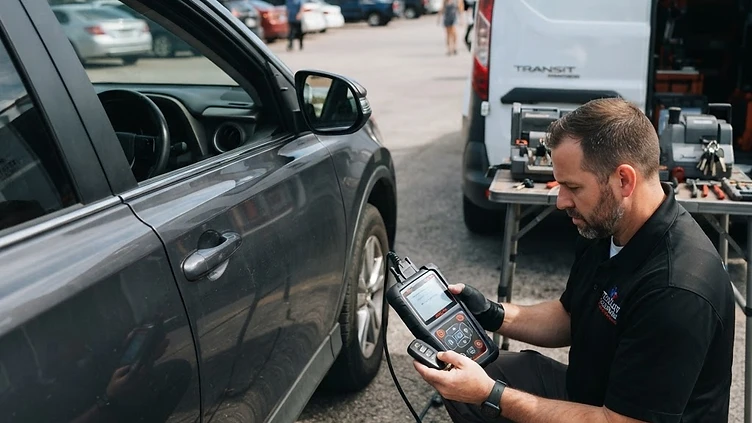
Programming is the reason these can't be solved at a hardware store. The fob has to be taught to the vehicle, and on most modern cars that requires a diagnostic interface the dealer and the auto locksmith have and most people don't.
Two things worth knowing before you buy a fob online: a cut key plus a blank chip is not a working key until it's programmed, and not every vehicle accepts third-party fobs. Our fob programming guide and fob replacement overview cover what's involved.
What does not need an auto locksmith
- A flat battery. That's a jump start.
- A fob with a dead cell. Watch for the weak signal and change the battery yourself; our Fort Worth guide covers it.
- A car that won't start at all and shows no immobilizer warning. That's a mechanic.
- A key that works but the door won't latch. That's a body shop or a door adjustment.
What to have ready before they arrive
Registration or title, your photo ID, the VIN, the year, make and model, and the location of the car. Be ready for the vehicle to be unlocked and accessible, and clear anything you'd rather not have photographed out of the passenger side of the car.
Any legitimate automotive locksmith will ask for proof of ownership. If that question never comes, be suspicious; it exists to protect the car you're standing next to.
When to call a pro
Call an automotive locksmith for a lockout, a lost or broken key, an ignition fault or a fob that needs programming. Call before you attempt the coat hanger. Our automotive team covers Dallas, Fort Worth, Irving, Arlington, Grand Prairie and the surrounding cities around the clock.
Call DFW Key Master at (682) 666-2966.
FAQ
Is a locksmith cheaper than a dealership for a car key?
Usually, and it's faster because the work happens where the car is. The gap is largest on key replacement and smallest on the newest vehicles with strict programming requirements.
Can an auto locksmith make a key with no original?
Yes, from the VIN and the manufacturer's code, with proof of ownership. Some very new models require dealer-side steps; ask before you commit.
Will a locksmith damage my car opening it?
A trained technician with the right tools shouldn't. Improvised tools are what cause bent linkages, damaged seals and scratched paint.
Do I need to be present?
Yes. Ownership documents and ID are checked on site, and the vehicle needs to be accessible.
Call before the coat hanger. DFW Key Master at (682) 666-2966.